


Mahindra 575 DI vs 585 DI Which Tractor Is Right for You
Dec 17, 2025 | 8 Mins Read


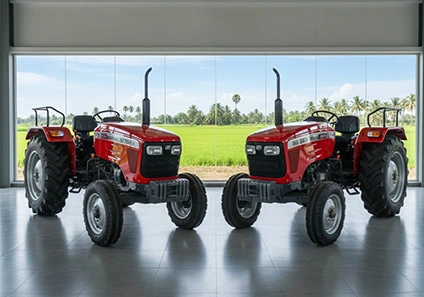
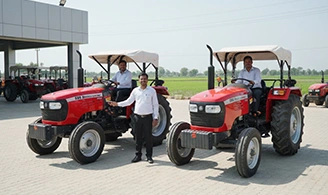
Choosing the right tractor is a critical decision for any farmer or farm-manager. In the 45-50 HP class, two popular models from Mahindra stand out: the 575 DI XP Plus and the 585 DI XP Plus. Though they sit close in power band and market segment, the nuances—engine size, torque, hydraulics, towing/lift capacity and price—can affect farming efficiency, running cost and ROI. This blog walks through both tractors in detail and provides guidance on which may suit your farm better.
Key Specifications Compared
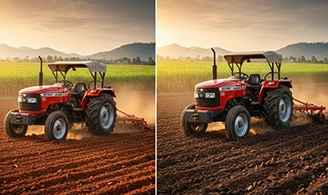
Here’s how the two models stack up based on reliable comparison data.
Engine & Power
- The 575 DI XP Plus is listed with around 47 HP (≈35 kW) and engine displacement of about 2,979 cc.
- The 585 DI XP Plus offers about 50 HP, engine rated 36.75 kW, torque ~215 Nm, and engine displacement ~3,054 cc in some listings.
- The rated RPM differs too: the 575 runs at ~2,000 RPM and the 585 at ~2,100 RPM.
Transmission, Gears & PTO
- Both have 8 forward + 2 reverse gears.
- The 575 uses a Partial Constant Mesh gearbox, while many listings say the 585 uses Full Constant Mesh (or at least a higher spec) for smoother operation.
- PTO power: 575 ~42 HP, 585 ~46 HP or more depending on variant.
Hydraulics & Lift Capacity
- The 575 usually lists hydraulic lift ~1,500 kg.
- The 585 offers higher lift capacity (≈1,800 kg) per comparison websites.
Fuel Tank, Build & Driving Comfort
- Fuel tank and some ergonomics favour the 585 (e.g., slightly larger tank in some data) but exact numbers vary by variant.
- Both are 2WD models commonly (though Mahindra may offer 4WD options in some series).
- Steering, braking and operator comfort are improved in the 585 (dual acting power steering, oil-immersed brakes) which may make a difference for heavy usage.
Price
- The 575 DI XP Plus is listed with ex-showroom ranges around ₹7.38 lakh to ₹7.78 lakh (depending on region) per listings.
- The 585 DI XP Plus starts around ₹7.49 lakh to ₹7.81 lakh or more, reflecting the higher spec.
- Always check your local on-road price (taxes, transport, state variations) as it will differ.
Practical Considerations: Which Tractor Suits Your Farm?
1. Farm Size & Workload
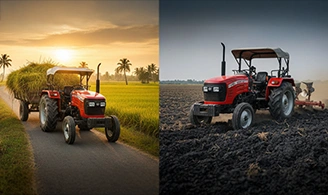
- If your landholding is medium (say up to ~10-15 acres) and you use moderate implements (single-furrow plough, small harrow, transport trailer), then the 575 may provide excellent value.
- If you run larger blocks, heavier implements, or custom-hire operations where more torque, lift and durability matter, the 585 makes more sense.
2. Soil Conditions & Terrain
- Sticky clay soils, deep tillage, heavier ploughs will benefit from the extra horsepower and lift of the 585.
- For lighter soils, general cropping (maize, pulses, etc.), the 575 may have enough power while offering better fuel economy.
3. Implements & Attachments
- If you plan to use large implements (multi-furrow plough, heavy harrow, tipping trailer), match your PTO/lift capacity accordingly. The 585’s higher hydraulic lift gives more room.
- If your implements are moderate sized, the 575 will manage, with less excess capacity to pay for.
4. Running Cost, Fuel Efficiency & Resale
- A higher spec tractor like the 585 may cost more to run (fuel, maintenance) though it offers more capability.
- If the extra capacity remains idle much of the time, you may under-utilise investment. In that case, the 575 may achieve better return for money.
- Resale value may also slightly favour the higher spec model if demand exists.
5. Dealer Network & Service
- Mahindra has a wide service network, but confirm in your region the parts availability for both models. A slightly simpler gearbox (575) may mean fewer complications.
- If you operate long hours or multi-crop rotations, the full spec of the 585 may provide greater reliability over time.
Pros & Cons: Side-by-Side
| Feature | 575 DI XP Plus | 585 DI XP Plus |
|---|---|---|
| Horsepower | ~47 HP | ~50 HP (higher) |
| Engine size & torque | Good for medium work | Slightly larger engine, higher torque (~215 Nm) |
| Hydraulics / lift | ~1,500 kg lift | Higher lift (~1,800 kg) |
| Transmission | Partial Constant Mesh | Full Constant Mesh (smoother, durable) |
| Price | Lower cost entry in this band | Higher investment cost |
| Fuel & running cost | Likely a bit lower | Slightly higher cost, but higher capability |
| Ideal for | Moderate farms, lighter use | Heavier duty, larger farms or custom hire |
| Risk of over-spec | Lower | If under-utilised, cost may not justify |
Decision Guide: How to Choose
1. What is your farm size and cropping intensity?
- If ≤ ~10-15 acres, moderate implement use → lean toward 575.
- If >15 acres, heavy implements, deeper tillage → consider 585.
2. What is your soil type and terrain?
- Lighter soils, less challenging terrain → 575 is adequate.
- Heavy soils, clay, large trailers, need for extra lift → 585 works better.
3. Will you fully utilise the extra power & features?
- If yes (custom hiring, heavy transport), then 585.
- If not, 575 likely gives better value.
4. Budget and cost of ownership
- If budget is tight, or running cost must be minimised → go 575.
- If you have margin and need premium features → pick 585.
5. Check demo and comfort
- Ride both, check ergonomics, servicing cost, resale value.
- Ask dealer about local support for higher spec gearbox.
Final Thoughts

In the debate Mahindra 575 DI vs 585 DI, there’s no one-size-fits-all answer. If you seek a robust, trusted 45-50 HP class tractor and your workload is moderate, the 575 DI XP Plus will serve you well—offering strong performance and better value. However, if your farming operation demands heavier tasks, large implements, and frequent use, the 585 DI XP Plus gives you the extra headroom, lift capacity and smooth transmission that add up over time.
Your ideal choice will depend on your farm size, implement set, soil conditions, budget and future growth plans. If you want to keep costs low and avoid paying for unused power, go with the 575. If you plan to scale, need heavy duty capacity now, or run machinery as business, invest in the 585.
Before finalising, make sure to check with your local Mahindra dealer for the exact on-road price in your state, available subsidies, finance offers, and variants available. Truly understanding how you’ll use the tractor will help you maximise ROI and avoid over-investing in under-used capacity.
Whichever model you pick, choosing the right tractor ensures smoother operations, better productivity and higher returns from your farm assets.
Recent Articles
Tag Cloud
Connect With Us

Dec 15, 2025
Dec 22, 2025

You May Also Like
- Read More
 Which is the Best Tractor for Farming in India?
Farming tractors are the essential companions of farmers; these robust machines help them work...
- Read More
 Choosing the Right Tractor for Groundnut Farming
Groundnut, or peanut, is grown in five states of India, namely Andhra Pradesh, Gujarat, Tamil Nadu, Karnataka, Rajasthan and Maharashtra.
- Read More
 Mahindra’s Tractor’s Potato Farming Guide
Paddy farming is one of India’s most prevalent farming methods that use small, flooded fields to cultivate rice.
- Read More
 Why Buy a Mahindra 275 DI XP Plus Tractor: Mileage, Features & Specs
The Indian Tractor market is unique—farmers are looking for an all-rounder tractor that satisfies all their needs while being affordable and powerful. One such tractor that meets the demands of Indian farmers is the Mahindra 275


 Not happy
 Could be better
 It's okay
 Good
Good Excellent