


AI in Indian Agriculture: Transforming Farming with Smart Technology
Nov 8, 2025 | 8 Mins Read


Introduction: Why AI Matters for Indian Farming

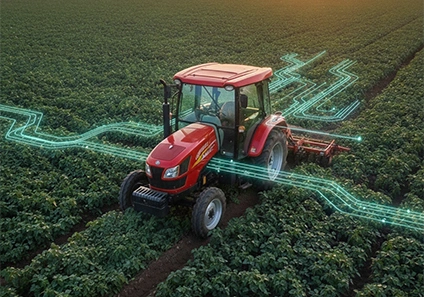
Agriculture remains a critical pillar of India’s economy, livelihood, and food security. But Indian farmers often struggle with volatile weather, fluctuating input costs, crop pests, disease outbreaks, fragmented land holdings, and limited access to real-time advisory services.
That’s where AI agriculture (i.e. applying artificial intelligence methods—machine learning, computer vision, sensor analytics—to farming) comes into play. AI in agriculture promises to help farmers make smarter decisions—when to sow, how much water or fertiliser to apply, how to detect disease early, and how to optimize yields.
AI agriculture in India is gaining momentum, with pilots, government support, and agritech startups driving change. AI offers major gains in pest control, crop monitoring, precision farming, and more—helping Indian farming become more sustainable, efficient, and profitable.
In this blog, we’ll explore:
- Key applications of AI in Indian agriculture
- Real-world examples and success stories
- Government & institutional support
- Challenges & limitations
- The roadmap ahead
Key Applications: How AI is Transforming Indian Agriculture
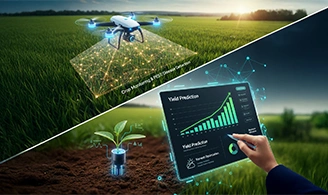
Here are the major domains in which AI agriculture in India is making inroads:
1. Precision Farming & Crop Monitoring
Instead of uniform fertilizer or water application across an entire field, AI systems use satellites, drones, sensors, and imaging to map variability within a field. Algorithms then prescribe zones that need more or less water, nutrients, or treatment, improving efficiency and yield.
Farmonaut highlights this as a key way AI is changing agriculture in India. Invest India also notes that AI combined with IoT enables real-time data-driven decision-making.
2. Pest / Disease Detection & Forecasting
Using computer vision and historical data, AI can detect early signs of crop disease or pest attacks—often before visible symptoms appear. In sugarcane farms in Maharashtra, AI helped predict pest pressure, optimize spray timing, and increase sucrose yield by approximately 20%.
3. Smart Irrigation / Water Management
Water scarcity is a major challenge across India. AI models combining weather forecasts, soil moisture data, and crop models enable precise irrigation scheduling, significantly reducing water waste.
4. Yield Prediction & Crop Planning
AI models analyze satellite imagery, weather patterns, soil data, and historical yields to forecast crop output. This helps farmers plan storage, marketing, and input usage more effectively.
The World Economic Forum’s “Future Farming in India” playbook emphasizes AI-enabled yield estimation and crop planning.
5. Supply Chain, Market Linkages & Price Forecasting
AI helps match supply with demand, predict market prices, and reduce post-harvest losses. In India, Microsoft collaborated with the Karnataka government to develop AI-driven price forecasting models using weather, remote sensing, and historical data.
6. Automation, Robotics & Farm Equipment
AI-powered robots, autonomous vehicles, and drones for spraying and weeding are emerging. For example, IIT Kharagpur researchers developed a pest-spraying robot that detects diseased plants and treats them precisely.
7. Advisory Systems & Farmer Support Tools
AI-based chatbots and decision-support systems provide farmers with localized advice in regional languages.
- KisanQRS: A deep learning system trained on 34 million farmer call logs
- AgriLLM: A transformer-based model answering farmer queries
Real-World Examples & Success Stories

- Microsoft & Karnataka Government: An MoU signed in 2017 to empower smallholder farmers through AI-driven crop advisory and price forecasting in collaboration with the Karnataka Agricultural Price Commission.
- Sugarcane in Baramati, Maharashtra: AI-driven analysis of weather, soil, and nutrients improved yields while reducing water and fertilizer use.
- Saagu Baagu, Telangana: Under the AI4AI initiative, 7,000 chili farmers doubled yields and incomes using AI tools.
- Jharkhand Farmer (Sundarban Krishi Vatika): Adoption of soil sensors, cameras, and automated irrigation controlled via mobile apps.
Institutional & Government Push

- ₹4,179 crores allocated (2020–22) for agricultural technologies including AI, drones, GIS, and remote sensing
- ICAR and allied institutions funded for AI R&D and farmer training
- WEF–BCG “Future Farming in India” IMPACT AI framework
- AI4AI initiative supporting agritech innovation and farmer adoption
Challenges & Barriers to Adoption
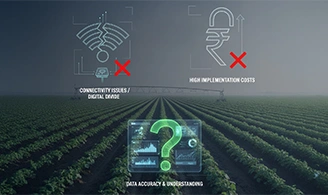
1. Infrastructure & Connectivity Gaps
Many rural regions lack stable internet, power, and sensor infrastructure.
2. High Upfront Costs / Affordability
Sensors, drones, and robotics require investments beyond the reach of many small farmers.
3. Limited Data & Ground Truth
Inadequate historical and real-time data affects AI model accuracy.
4. Skill & Trust Gaps
Farmers may distrust AI systems or lack training to use them effectively.
5. Fragmented Land Holdings
Small and scattered plots complicate AI deployment at scale.
6. Scalability & Localization
AI solutions must adapt to local soil, crop, and climate conditions.
7. Regulatory, Privacy & Data Ownership Concerns
Unclear data ownership and privacy policies may hinder adoption.
The Road Ahead & Future Prospects

- Affordable AI tools tailored for smallholder farmers
- Federated data-sharing models with privacy protection
- Open agricultural datasets and digital infrastructure
- Modular and interoperable AI systems
- Stronger extension services and agritech hubs
- Policy incentives, subsidies, and regulatory clarity
- AI models supporting climate-resilient farming
As highlighted in the WEF IMPACT AI framework and StartUs Insights, AI adoption in agriculture is set to scale rapidly through enabling platforms and innovation ecosystems.
Explore more farming insights in our blogs section: Mahindra Tractors
Conclusion
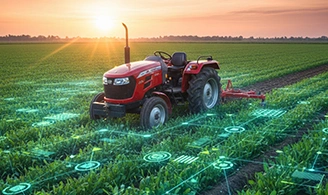
The integration of AI into Indian agriculture is no longer optional—it is becoming essential. By optimizing inputs, detecting disease early, improving water use, and guiding market decisions, AI agriculture can significantly improve yields, resilience, and farm incomes.
With growing support from government, startups, and research institutions, AI has the potential to transform Indian agriculture at scale and secure the future of farming.
Recent Articles
Tag Cloud
Connect With Us

Nov 5, 2025
Nov 10, 2025

You May Also Like
- Read More
 Which is the Best Tractor for Farming in India?
Farming tractors are the essential companions of farmers; these robust machines help them work...
- Read More
 Choosing the Right Tractor for Groundnut Farming
Groundnut, or peanut, is grown in five states of India, namely Andhra Pradesh, Gujarat, Tamil Nadu, Karnataka, Rajasthan and Maharashtra.
- Read More
 Mahindra’s Tractor’s Potato Farming Guide
Paddy farming is one of India’s most prevalent farming methods that use small, flooded fields to cultivate rice.
- Read More
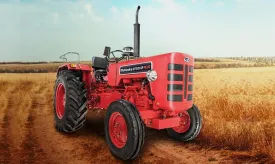 Why Buy a Mahindra 275 DI XP Plus Tractor: Mileage, Features & Specs
The Indian Tractor market is unique—farmers are looking for an all-rounder tractor that satisfies all their needs while being affordable and powerful. One such tractor that meets the demands of Indian farmers is the Mahindra 275


 Not happy
 Could be better
 It's okay
 Good
Good Excellent