


Top 5 Rice Farming States in India: Production & Insights
Nov 12, 2025 | 6 Mins Read


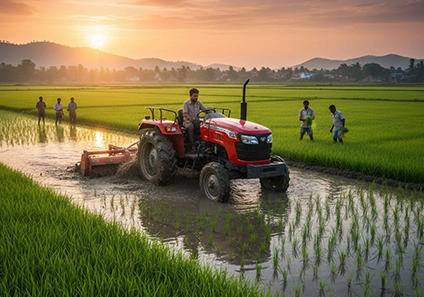
Rice continues to be one of the most important staple crops in India, shaping the livelihoods of millions of farmers and the food security of the nation. In the context of rice farming in India, certain states dominate the production landscape thanks to favourable agro-climatic conditions, irrigation infrastructure, and mechanisation. Here we dive into the top five rice-producing states, examine what drives their success, and highlight insights you should know if you’re interested in rice farming or policy.
Telangana
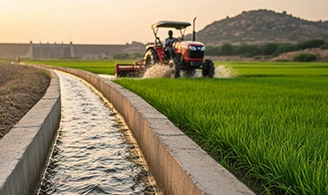
In recent years, Telangana has surged to the top of the rice production charts. According to data for 2023–24, the state produced about 168.80 lakh tonnes of rice, making it the leading rice producing state nationally.
Why it stands out
- Large area under paddy with access to irrigation reservoirs and canal networks supporting both Kharif and Rabi rice farming.
- Adoption of mechanisation and improved seed varieties tailored for the Deccan Plateau.
- Government schemes focused on procurement and market linkages strengthen the rice farming chain.
Insight
For farmers or investors, rice farming in Telangana offers relatively stable yield potential, but water-use efficiency, rising input costs, and labour dynamics must be carefully managed.
Uttar Pradesh
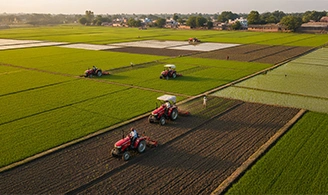
Uttar Pradesh remains a powerhouse for rice production, with roughly 159.90 lakh tonnes reported for 2023–24.
Key factors
- Vast fertile alluvial plains of the Ganga and its tributaries enable large-scale rice farming.
- Strong tradition of rice cultivation across small and medium-sized farms.
- Access to markets and procurement systems through state-run agencies.
Insight
Rice farming in Uttar Pradesh typically involves medium-sized holdings, offering scalability, but challenges such as soil degradation, labour shortages, and climate variability persist.
West Bengal
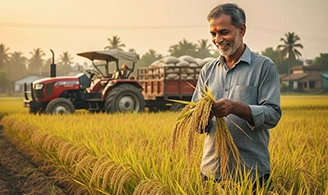
Traditionally the top rice producing state, West Bengal produced approximately 156.90 lakh tonnes in 2023–24.
Highlights
- Deep-rooted rice farming traditions supported by rich soils, abundant water bodies, and a large paddy-growing area.
- Popular varieties include Swarna, IR36, and Sona Masuri.
- Dense population supports strong local demand and regional value-addition.
Insight
While rice farming in West Bengal remains large in scale, challenges such as climate change, flooding, and labour migration mean that adaptation and improved practices are increasingly important.
Also Read: Choosing the Right Implements for Rice Farming
Punjab
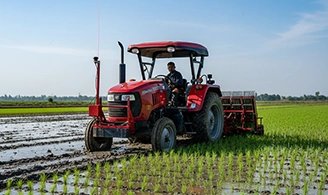
Punjab continues to be a major rice producing state with around 143.60 lakh tonnes in 2023–24.
Why it matters
- Highly mechanised, high-input rice farming with high-yielding and premium varieties, especially basmati.
- Strong procurement systems and export linkages for basmati rice.
- Use of technologies such as laser levelling, precision farming, and mechanised harvesting.
Insight
Punjab’s rice farming model demonstrates how mechanisation and premium rice markets can enhance returns, but it also raises concerns around higher input costs, water usage, and sustainability.
Odisha
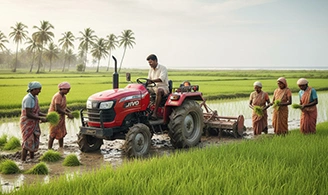
Though traditionally slightly lower ranked, Odisha produced about 84.70 lakh tonnes of rice in 2023–24, highlighting its growing importance.
Special features
- Rice farming across irrigated and rain-fed ecosystems, including tribal and coastal zones.
- Increased focus on climate-resilient varieties and extension services for marginal farmers.
- Emphasis on value-addition such as parboiled rice and local branding.
Insight
Rice farming in Odisha offers strong potential for inclusive growth, though managing monsoon variability and improving access to modern tools remain key challenges.
Wrap-Up: What Your Rice-Farming Stake Should Know
- Scale & yield matter: Each of these states contributes tens of millions of tonnes of rice annually, underlining rice’s role in India’s food security.
- Regional differences: Rice farming varies widely—from alluvial plains in Uttar Pradesh to mechanised systems in Punjab and rain-fed uplands in Odisha.
- Technology & adaptation: Mechanisation, efficient water use, improved seed varieties, and market linkages are key to sustained production.
- Sustainability concerns: Water usage, soil health, climate change, and labour availability are major challenges.
- Future prospects: With steady production and export potential, investments in storage, value-addition, and infrastructure offer new opportunities.
Rice farming is not just about planting and harvesting—it involves adapting to climate conditions, managing resources efficiently, and aligning with market demands. The top rice producing states in India each highlight different aspects of this complex yet vital agricultural ecosystem.
Recent Articles
Tag Cloud
Connect With Us

Nov 10, 2025
Nov 14, 2025

You May Also Like
- Read More
 Which is the Best Tractor for Farming in India?
Farming tractors are the essential companions of farmers; these robust machines help them work...
- Read More
 Choosing the Right Tractor for Groundnut Farming
Groundnut, or peanut, is grown in five states of India, namely Andhra Pradesh, Gujarat, Tamil Nadu, Karnataka, Rajasthan and Maharashtra.
- Read More
 Mahindra’s Tractor’s Potato Farming Guide
Paddy farming is one of India’s most prevalent farming methods that use small, flooded fields to cultivate rice.
- Read More
 Why Buy a Mahindra 275 DI XP Plus Tractor: Mileage, Features & Specs
The Indian Tractor market is unique—farmers are looking for an all-rounder tractor that satisfies all their needs while being affordable and powerful. One such tractor that meets the demands of Indian farmers is the Mahindra 275


 Not happy
 Could be better
 It's okay
 Good
Good Excellent