


Benefits Of e-National Agriculture Market (e-NAM) Scheme for Farmers
Nov 14, 2025 | 7 Mins Read



Agriculture marketing in India has long been challenged by fragmented mandis (market yards), lack of transparent pricing, limited buyer access, and delayed payments to farmers. The e-NAM scheme was introduced to transform this scenario. In this blog, we explore what e-NAM is and why it is a game-changer for farmers.
What is e-NAM?
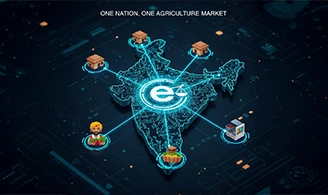
Launched in April 2016 by the Ministry of Agriculture & Farmers’ Welfare, the e-NAM scheme aims to build “One Nation, One Agriculture Market” by networking existing Agricultural Produce Market Committees (APMCs) and creating a unified electronic trading platform.
Through this digital portal, farmers, traders, buyers, processors, and Farmer Producer Organisations (FPOs) can list, trade, and settle transactions for a wide range of agricultural commodities.
How It Works (In a Farmer’s Context)
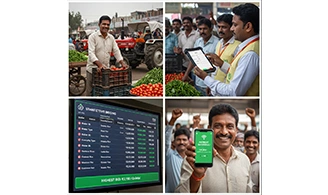
When a farmer brings produce to an e-NAM–enabled mandi, the following steps take place:
- Details of arrival such as quantity, grade, and photos are uploaded on the platform.
- Registered buyers from within the state or outside can view the lot and bid online.
- The highest bidding price is visible, enabling transparent price discovery.
- Once the farmer accepts the bid, payment is processed electronically into the farmer’s bank account.
- Optional modules allow trading from warehouses (via e-NWR) or FPO collection centres without physical mandi presence.
Major Benefits for Farmers

- Wider market access: Farmers are no longer restricted to a single local mandi and can reach buyers across states.
- Better price discovery: Real-time bidding reflects true market prices instead of dependence on middlemen.
- Transparency and reduced intermediation: Digital auctions reduce multiple intermediaries.
- Timely payment: Online payment integration ensures faster and secure bank transfers.
- Quality and grading recognition: Standardized assaying rewards better-quality produce.
- Lower transaction costs: Warehouse trading and digital workflows reduce handling and logistics expenses.
Also Read: 10 Key Government Schemes For Indian Agriculture Farmer
Eligibility Criteria for e-NAM

Unified Trading License Across the State/UT
- The State or Union Territory must permit a single trading license valid across the region.
- The licensing process should be simple and free from restrictive conditions.
Single-Point Market Fee Levy
- Market fees must be levied only once at the first wholesale transaction.
- No additional fees should be charged on subsequent wholesale trades.
Legal and Infrastructure Support for e-Trading
- States must provide legal and infrastructural support for e-auction and e-trading.
- Proposals must meet all core reforms to qualify for one-time infrastructure grants.
Commitments by the Applicant State/UT
- Ensure 100% trade of selected commodities through e-NAM in designated markets.
- Link markets with Soil Testing Laboratories (STLs).
- Bear implementation costs beyond sanctioned grants.
- Cover software maintenance costs after five years.
- Register implementing agencies on the PFMS portal.
Special Provisions for States/UTs Without an APMC Act
- Identify a suitable authority to manage e-trading.
- Frame enforceable guidelines for trader registration and transactions.
Eligibility for Private Markets
- Must be recommended by the competent authority.
- Required infrastructure and assaying facilities must be provided at their own cost.
Registration Guidelines for e-NAM Users
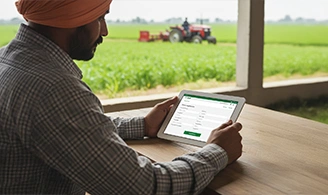
For Farmers
- Visit the e-NAM registration page and choose “Registration Type – Farmer.”
- Select your desired APMC (Agricultural Produce Market Committee).
- Enter a valid email ID, as your Login ID and Password will be sent to this address.
- After successful registration, check your email for your temporary login credentials.
- Log in to your dashboard through the e-NAM portal (www.enam.gov.in/web) using these details.
- On your dashboard, a flashing message— “Click here to register with APMC”—will appear. Click it to complete or update your profile details.
- Once your KYC verification is done, your application will be forwarded to the selected APMC for approval.
- You can track your application status (Submitted, In Progress, Approved, or Rejected) directly from your dashboard.
- After approval, you’ll receive your permanent e-NAM Farmer Login ID (e.g., HR866F00001) and password via email, granting full access to the e-NAM platform.
- Alternatively, you may contact your nearest Mandi/APMC for assistance with registration.
For Traders
- Visit this link and select “Registration Type – Trader.”
- Choose your relevant APMC or State-level option, and upload a passport-size photograph along with a valid email ID.
- Your Login ID and temporary password will be sent to your email.
- Log in at www.enam.gov.in, and click the flashing message “Click here to register with APMC.”
- Fill in or update your license and KYC details on the redirected registration page.
- Your application will be sent to the selected APMC or SAMB (in case of a unified license) for approval.
- Once submitted, you’ll receive an email confirming your application status (Submitted, In Progress, Approved, or Rejected).
- To obtain a permanent Trader Login ID (e.g., HR866T00001) and password, visit your respective Mandi/APMC to verify your license details.
- After approval, your official Trader/Commission Agent (CA) credentials will be emailed, enabling you to trade online through e-NAM.
Also Read: Which is the Best Tractor for Farming in India?
For FPOs / FPCs
- Name of the FPO/FPC.
- Details of authorized representative.
- Bank account details including IFSC code.
For State Mandi Boards
- Implement a unified trading license across the state.
- Ensure single-point levy of market fees.
- Introduce provisions for e-auction and e-trading.
Why This Is Particularly Beneficial for Small & Marginal Farmers

Small and marginal farmers often face limited buyer access and weak bargaining power. e-NAM bridges this gap by offering transparent pricing, broader market access, and digital tools that improve income potential and reduce marketing risks.
Some Considerations & the Way Ahead
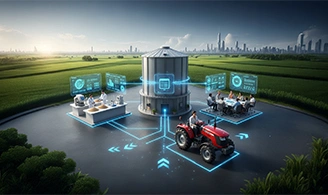
While e-NAM has immense potential, its success depends on infrastructure such as grading labs, digital connectivity, farmer awareness, and integration with warehousing and logistics. The government continues to expand warehouse-based and FPO-led trading modules to enhance reach.
Explore more farming insights in our blogs section: Mahindra Tractors
Conclusion

The e-NAM scheme is a transformative farmer-focused initiative reshaping agricultural marketing in India. By enabling wider access, fair pricing, faster payments, and reduced dependence on intermediaries, it strengthens farmer incomes and market efficiency. With proper infrastructure and awareness, e-NAM can become a powerful tool for farmers navigating today’s competitive agri-market landscape.
Recent Articles
Tag Cloud
Connect With Us


Nov 12, 2025
Nov 17, 2025

You May Also Like
- Read More
 Which is the Best Tractor for Farming in India?
Farming tractors are the essential companions of farmers; these robust machines help them work...
- Read More
 Choosing the Right Tractor for Groundnut Farming
Groundnut, or peanut, is grown in five states of India, namely Andhra Pradesh, Gujarat, Tamil Nadu, Karnataka, Rajasthan and Maharashtra.
- Read More
 Mahindra’s Tractor’s Potato Farming Guide
Paddy farming is one of India’s most prevalent farming methods that use small, flooded fields to cultivate rice.
- Read More
 Why Buy a Mahindra 275 DI XP Plus Tractor: Mileage, Features & Specs
The Indian Tractor market is unique—farmers are looking for an all-rounder tractor that satisfies all their needs while being affordable and powerful. One such tractor that meets the demands of Indian farmers is the Mahindra 275


 Not happy
 Could be better
 It's okay
 Good
Good Excellent