


How Much Does a Tractor Cost in India with EMI? Tractor EMI Guide
Jul 29, 2026 | 5 Mins Read


Table of Content
- What Is the Average Tractor Price in India?
- Why EMI Is the Preferred Option for Farmers?
- What Is a Tractor Loan?
- Understanding Tractor EMI
- Example EMI Calculation:
- Factors Affecting Tractor EMI
- Tractor Price with EMI Options: Sample estimates
- Why Use a Tractor Loan EMI Calculator?
- Benefits Of Using a Tractor Loan EMI Calculator
- Documents Usually Required For Tractor Loans
- Can small farmers get tractor loans?
- Tips To Reduce Tractor EMI
- Conclusion
Buying a tractor is one of the most important investments for any farmer. Whether you own a small farm, manage a large agricultural business, or plan to start custom hiring services, understanding the tractor price with EMI options can help you make a financially sound decision.
With easy financing available from banks, NBFCs, and tractor manufacturers, purchasing a tractor has become more accessible than ever. Instead of paying the entire amount upfront, farmers can spread the cost over several years through affordable tractor EMI plans.
In this guide, we'll explain tractor prices in India, EMI calculations, loan eligibility, financing options, and how a tractor loan EMI calculator can help you estimate monthly repayments before making a purchase.
What Is the Average Tractor Price in India?
The price of a tractor in India depends on several factors, including horsepower (HP), brand, engine capacity, transmission and available features.
Here's a general price range:
| Tractor Category | Approximate Price Range |
|---|---|
| Mini Tractors (15–30 HP) | ₹2.5 lakh – ₹5 lakh |
| Small Utility Tractors (31–40 HP) | ₹5 lakh – ₹7 lakh |
| Medium Tractors (41–50 HP) | ₹6.5 lakh – ₹9 lakh |
| Heavy-Duty Tractors (Above 50 HP) | ₹8 lakh – ₹16 lakh+ |

The final on-road cost may also include:
- Registration charges
- Insurance
- Road tax (where applicable)
- Accessories
- Implements purchased with the tractor
- Extended warranty packages
Because tractors are available in various price segments, financing becomes an important factor in choosing the right model.
Why EMI Is the Preferred Option for Farmers?
Very few farmers pay the complete tractor price upfront.

Instead, they choose tractor EMI financing because it offers several advantages:
- Lower initial financial burden
- Better cash flow management
- Opportunity to invest remaining capital in seeds, fertilizers, irrigation, and labour
- Flexible repayment periods
- Easy access to higher-capacity tractors
Instead of waiting years to accumulate enough savings, EMI financing enables farmers to start using the tractor immediately while repaying the loan gradually.
What Is a Tractor Loan?
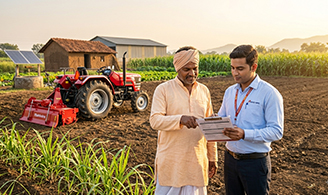
A tractor loan is a specialized agricultural loan offered for purchasing new or used tractors.
Most lenders finance:
- New tractors
- Used tractors
- Farm implements
- Rotavators
- Cultivators
- Seed drills
- Agricultural equipment
Loan repayment is generally spread over 3–7 years depending on the lender and the farmer's repayment capacity.
Understanding Tractor EMI
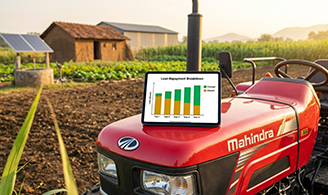
EMI stands for Equated Monthly Installment.
Each monthly payment includes:
- Principal amount
- Interest amount
Initially, a larger portion of the EMI goes toward interest. As the loan progresses, more of the payment contributes toward reducing the principal.
Example EMI Calculation:
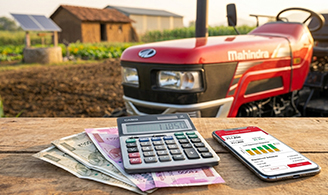
Suppose you purchase a tractor worth ₹7 lakh.
- Down payment: ₹1.4 lakh (20%)
- Loan amount: ₹5.6 lakh
- Interest rate: 9%
- Loan tenure: 5 years
Your estimated tractor EMI would be approximately ₹11,600–₹12,000 per month, depending on lender charges and exact interest rates.
These values are only indicative. Actual EMI varies based on financing terms.
Factors Affecting Tractor EMI
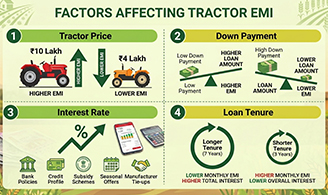
1. Tractor price
The higher the tractor price, the larger the loan amount and EMI.
A ₹4 lakh tractor naturally attracts lower installments than a ₹10 lakh tractor.
2. Down payment
Making a larger down payment reduces the borrowed amount.
Lower loan amount means:
- Lower monthly EMI
- Lower total interest paid
- Faster loan repayment
Many lenders finance up to 80–90% of the tractor's value.
3. Interest rate
Agricultural loan interest rates vary based on:
- Bank policies
- Credit profile
- Government subsidy schemes
- Seasonal offers
- Manufacturer tie-ups
Even a 1% reduction in interest can significantly reduce total repayment over five to seven years.
4. Loan Tenure
Longer loan tenure:
- Lower monthly EMI
- Higher total interest paid
Shorter tenure:
- Higher monthly EMI
- Lower overall interest
Farmers should select a repayment period that balances affordability with total borrowing cost.
Tractor Price with EMI Options: Sample estimates
The following examples illustrate how EMI changes with tractor prices.
| Tractor Price | Down Payment (20%) | Loan Amount | Approximate EMI (5 Years) |
|---|---|---|---|
| ₹4 lakh | ₹80,000 | ₹3.2 lakh | ₹6,600–₹6,900 |
| ₹6 lakh | ₹1.2 lakh | ₹4.8 lakh | ₹9,900–₹10,300 |
| ₹8 lakh | ₹1.6 lakh | ₹6.4 lakh | ₹13,200–₹13,700 |
| ₹10 lakh | ₹2 lakh | ₹8 lakh | ₹16,500–₹17,100 |
These are approximate figures based on standard financing assumptions and may differ depending on lender policies.
Why Use a Tractor Loan EMI Calculator?
Before applying for finance, farmers should use a tractor loan EMI calculator.

It helps estimate:
- Monthly EMI
- Total interest payable
- Total repayment amount
- Effect of changing tenure
- Effect of different down payments
Instead of manually calculating complex loan formulas, an EMI calculator delivers instant results.
This helps farmers compare multiple tractors before making a purchase decision.
Benefits Of Using a Tractor Loan EMI Calculator
Using a tractor loan EMI calculator offers several advantages.
1. Better Budget Planning
Farmers can determine whether the EMI comfortably fits their monthly income.
2. Compare different tractors
Changing the loan amount instantly shows how EMI changes.
3. Adjust Loan Tenure
Users can compare:
- 3-year loan
- 5-year loan
- 7-year loan
to find the best repayment option.
4. Plan Down Payment
Increasing the down payment immediately reduces monthly installments.
This enables smarter financial planning before approaching a lender.
Documents Usually Required For Tractor Loans
Most banks and finance companies ask for basic documentation.
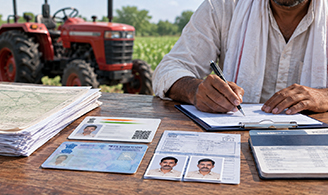
These generally include:
- Aadhaar Card
- PAN Card
- Passport-size photographs
- Address proof
- Identity proof
- Land ownership records or cultivation proof
- Income proof (if applicable)
- Bank account statements
Requirements may differ between lenders.
Can small farmers get tractor loans?
Yes, small famers can get tractor loans.
Most agricultural lenders actively finance small and marginal farmers.

Several banks offer:
- Flexible repayment schedules
- Seasonal EMI options
- Crop-cycle based repayment
- Lower agricultural lending rates
- Government-supported financing schemes
Farmers with limited landholding may also qualify depending on repayment capacity and lender policies.
Tips To Reduce Tractor EMI
Buying a tractor is a long-term commitment. These strategies can help lower your financial burden.
1. Make a bigger down payment
Even a slightly higher upfront payment can substantially reduce both EMI and interest.
2. Choose the right horsepower
Avoid buying a tractor that's larger than your farming needs.
Selecting the correct horsepower saves money not only on purchase but also on fuel and maintenance.
3. Compare multiple lenders
Interest rates vary among:
- Public sector banks
- Cooperative banks
- Private finance companies
- Manufacturer financing divisions
Comparing loan offers can save thousands of rupees over the loan period.
4. Select a comfortable tenure
Don't choose the shortest tenure just to finish the loan quickly.
Likewise, avoid unnecessarily long tenures that increase interest costs.
Choose an EMI you can comfortably pay every month.
Should you buy a tractor on EMI?
For most Indian farmers, the answer is yes.
Purchasing a tractor through tractor EMI financing allows immediate access to modern farm machinery without exhausting savings.
However, the tractor should generate sufficient value through:
- Improved farm productivity
- Reduced labour costs
- Timely farming operations
- Transportation work
- Custom hiring income
If the tractor remains underutilized, loan repayment may become difficult.
Therefore, buying should always be based on expected annual usage rather than aspiration alone.
Conclusion
Understanding the tractor price with EMI options is essential before investing in a new tractor. While the purchase price is important, farmers should also evaluate the total cost of ownership, including interest, maintenance, fuel, and insurance.
A well-planned tractor EMI allows farmers to preserve working capital while improving farm productivity. Before finalizing any purchase, use a reliable tractor loan EMI calculator to compare different loan amounts, tenures, and down payment options. This simple step can help you choose an affordable repayment plan that aligns with your farming income.
With careful financial planning, the right tractor and the right loan can become valuable assets that increase efficiency, reduce operational costs, and support long-term agricultural growth.
Recent Articles
Tag Cloud
Connect With Us

Jul 29, 2026
Jul 29, 2026

You May Also Like
- Read More
 Which is the Best Tractor for Farming in India?
Farming tractors are the essential companions of farmers; these robust machines help them work...
- Read More
 Choosing the Right Tractor for Groundnut Farming
Groundnut, or peanut, is grown in five states of India, namely Andhra Pradesh, Gujarat, Tamil Nadu, Karnataka, Rajasthan and Maharashtra.
- Read More
 Mahindra’s Tractor’s Potato Farming Guide
Paddy farming is one of India’s most prevalent farming methods that use small, flooded fields to cultivate rice.
- Read More
 Why Buy a Mahindra 275 DI XP Plus Tractor: Mileage, Features & Specs
The Indian Tractor market is unique—farmers are looking for an all-rounder tractor that satisfies all their needs while being affordable and powerful. One such tractor that meets the demands of Indian farmers is the Mahindra 275


 Not happy
 Could be better
 It's okay
 Good
Good Excellent