


Renting vs Buying a Tractor in India: Which Is Better for Small Farmers?
Jul 29, 2026 | 5 Mins Read


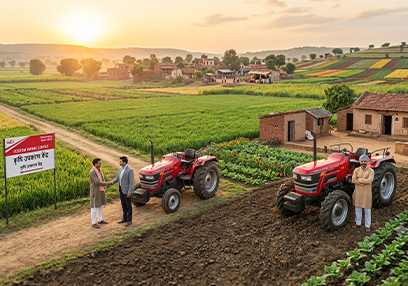
Table of Content
- Why Choosing Between Renting and Buying Matters
- Tractor Rental in India: Costs and How It Works
- Typical Rental Charges Include:
- Benefits of Renting a Tractor
- Challenges Of Tractor Rental
- Understanding Tractor Ownership
- Benefits Of Buying a Tractor
- Disadvantages Of Buying
- Tractor For Small Farm: Which Option Makes More Sense?
- Is a Mini Tractor a Better Option for Small Farms?
- Questions to ask before you decide
- Conclusion: Should You Rent or Buy a Tractor?
For millions of Indian farmers, owning a tractor is a dream that promises greater productivity, faster field operations, and reduced dependence on manual labour. However, buying a tractor is also one of the biggest financial decisions a farmer can make.
With the growing availability of tractor rental services and Custom Hiring Centres (CHCs), many small farmers are asking an important question: Should I buy or rent a tractor for farming?
The answer depends on several factors, including farm size, annual tractor usage, financial capacity, and long-term farming goals. This guide compares the costs and benefits of both options to help you make the right decision.
Why Choosing Between Renting and Buying Matters
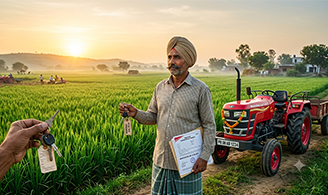
For small and marginal farmers, every investment directly impacts profitability. A tractor improves efficiency during land preparation, sowing, transportation, spraying, and harvesting. But owning one also means bearing expenses such as loan repayments, maintenance, insurance, fuel, and depreciation.
On the other hand, tractor rental offers flexibility without the burden of ownership. Farmers pay only when they need the machine, making it an attractive option for seasonal operations.
The right choice depends on how frequently the tractor will be used and whether ownership can generate sufficient returns over time.
Tractor Rental in India: Costs and How It Works
Today, tractor rental has become increasingly popular across India. Farmers can rent tractors on an hourly, per-acre, or per-operation basis through local tractor owners, Custom Hiring Centres, and digital rental platforms.
Typical Rental Charges Include:
- ₹800–₹1,500 per hour for common farming operations
- Higher charges for specialised implements and high-horsepower tractors
- Per-acre packages for operations like ploughing, rotavation, sowing, or residue management
Since the rental provider usually takes care of maintenance, insurance, servicing, and depreciation, farmers only pay for actual usage.
Benefits of Renting a Tractor
1. Lower initial investment
The biggest benefit of renting is that it eliminates the need for a large upfront payment. Farmers don't have to arrange lakhs of rupees or take agricultural loans.
2. No EMI burden
When you rent, there are no monthly loan repayments. This improves cash flow and allows farmers to invest in better seeds, fertilisers, irrigation, or crop protection.
3. Zero maintenance costs
Repair bills, engine servicing, tyre replacement, insurance renewals, and registration expenses remain the owner's responsibility.
4. Access to different machines
Different crops require different implements. Renting allows farmers to choose the right tractor horsepower and attachment without owning multiple machines.
5. Ideal for seasonal farming
If your tractor requirement is limited to ploughing before sowing and transportation during harvest, renting may be the most economical option.
Challenges Of Tractor Rental
Although renting offers many advantages, it isn't perfect.
1. Availability issues
During peak sowing and harvesting seasons, demand for rental tractors increases sharply. Farmers may have to wait, leading to delayed operations.
2. Limited flexibility
Since the tractor belongs to someone else, farmers cannot use it whenever they want.
3. Recurring expense
Although individual rental charges appear affordable, repeated rentals throughout the year can become expensive if tractor usage increases.
Understanding Tractor Ownership
Buying a tractor provides complete independence and long-term convenience. However, it also requires significant investment.
Entry-level tractors in India generally start around ₹2.45 lakh, while popular 36-40 HP models often cost between ₹5.5 lakh and ₹9.2 lakh. Besides the purchase price, ownership includes:

- Down payment
- Loan EMIs
- Registration
- Insurance
- Fuel
- Servicing
- Repairs
- Tyre replacement
- Depreciation
For example, purchasing a ₹7 lakh tractor with financing could result in monthly EMIs of approximately ₹13,000-₹14,000 over five years, before adding annual maintenance and insurance expenses.
Benefits Of Buying a Tractor
1. Complete availability
The biggest advantage is immediate access. Farmers can begin work whenever weather conditions are favourable.
2. Better farm management
Timely sowing and harvesting often lead to higher yields. Having your own tractor reduces dependence on outside availability.
3. Long-term savings
If the tractor is used extensively every year, ownership can become cheaper than repeated rentals.
4. Additional income
Many farmers recover ownership costs by renting their tractor to neighbouring farms during idle periods.
5. Asset creation
Unlike rental payments, buying builds ownership of a valuable agricultural asset that retains resale value.
Disadvantages Of Buying
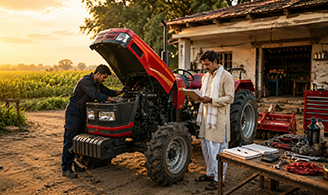
Ownership also brings several responsibilities:
- High initial investment
- Monthly EMI obligations
- Maintenance expenses
- Insurance renewal
- Fuel costs
- Depreciation over time
- Storage requirements
If the tractor remains unused for much of the year, these fixed expenses continue regardless of farm activity.
Tractor For Small Farm: Which Option Makes More Sense?
Choosing the right tractor for small farm operations depends mainly on annual usage.
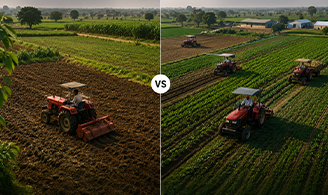
Renting works best if:
- You own less than 5–7 acres.
- Tractor usage is below 150–200 hours annually.
- Farming is seasonal.
- Cash flow is limited.
- You don't want maintenance responsibilities.
- Reliable rental services are available nearby.
Buying makes sense if:
- You cultivate larger landholdings.
- Multiple cropping seasons require frequent tractor use.
- Annual usage is high.
- You want complete operational control.
- You plan to earn extra income through custom hiring.
- Rental availability is unreliable during peak seasons.
Industry experts generally suggest comparing annual rental expenses with annual ownership costs. If yearly rental remains significantly lower than ownership, renting is usually the smarter financial decision.
Is a Mini Tractor a Better Option for Small Farms?
Many small farmers don't require high-horsepower tractors. Compact machines are often sufficient for orchards, vineyards, vegetable farming, and smaller fields.
The mini tractor price is considerably lower than larger models, making ownership more affordable. Besides the lower purchase price, mini tractors usually offer:
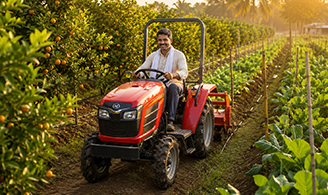
- Better fuel efficiency
- Lower maintenance costs
- Easier manoeuvrability
- Reduced operating expenses
- Suitability for narrow farm spaces
For farmers considering ownership but concerned about affordability, a mini tractor can provide an excellent balance between cost and productivity.
Questions to ask before you decide
If you're still wondering whether to buy or rent tractor for farming, ask yourself these questions:

- How many hours will I use the tractor every year?
- Can I comfortably afford loan repayments?
- Are rental tractors easily available in my village?
- Will delayed tractor availability affect my crop yield?
- Can I generate extra income by renting my tractor to other farmers?
- Would a mini tractor be sufficient for my farming needs?
Honest answers to these questions often make the decision much easier.
Conclusion: Should You Rent or Buy a Tractor?
There is no one-size-fits-all answer when choosing between renting and buying a tractor.
For most small and marginal farmers with limited land and seasonal requirements, tractor rental remains the most economical and low-risk solution. It avoids heavy investments while providing access to modern machinery whenever required.
However, farmers with larger landholdings, higher annual tractor usage, or opportunities to earn through custom hiring may find ownership more profitable in the long run. In such cases, exploring an affordable tractor for small farm or evaluating the mini tractor price can make buying a practical and financially sound investment.
Ultimately, the smartest decision is based not on emotions but on careful cost analysis, expected usage, and long-term farming goals. Before deciding whether to buy or rent tractor for farming, compare your annual operating costs, available capital, and workload to choose the option that delivers the best return on investment.
Recent Articles
Tag Cloud
Connect With Us

Jul 28, 2026
Jul 29, 2026

You May Also Like
- Read More
 Which is the Best Tractor for Farming in India?
Farming tractors are the essential companions of farmers; these robust machines help them work...
- Read More
 Choosing the Right Tractor for Groundnut Farming
Groundnut, or peanut, is grown in five states of India, namely Andhra Pradesh, Gujarat, Tamil Nadu, Karnataka, Rajasthan and Maharashtra.
- Read More
 Mahindra’s Tractor’s Potato Farming Guide
Paddy farming is one of India’s most prevalent farming methods that use small, flooded fields to cultivate rice.
- Read More
 Why Buy a Mahindra 275 DI XP Plus Tractor: Mileage, Features & Specs
The Indian Tractor market is unique—farmers are looking for an all-rounder tractor that satisfies all their needs while being affordable and powerful. One such tractor that meets the demands of Indian farmers is the Mahindra 275


 Not happy
 Could be better
 It's okay
 Good
Good Excellent