


Best Paddy Harvester Machines: Types, Capacity & Buying Guide
Sep 29, 2026 | 5 Mins Read


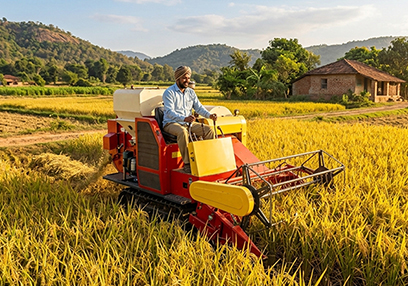
Table of Content
- Why Paddy Harvesters Are Important for Small Farms
- Types of Paddy Harvester Machines
- Understanding Harvester Capacity
- How to Choose the Right Paddy Harvester
- Rice Harvesting Machine Price: What Determines Cost?
- Fuel Efficiency and Operating Costs
- Maintenance Requirements
- Buying vs Hiring a Paddy Harvester
- Role of Mechanisation in Rice Farming
- Final Selection Checklist
- Conclusion
Paddy is one of India’s most important food crops, and efficient harvesting plays a crucial role in determining the profitability of rice farming. Once the crop reaches maturity, farmers need to harvest it at the right time to minimise grain losses, maintain quality, and prepare the field for the next crop. However, traditional harvesting methods can be labour-intensive, time-consuming, and increasingly difficult during peak harvesting periods.
Mechanisation offers an effective alternative. A suitable paddy harvester can help small farmers reduce harvesting time and labour requirements while improving operational efficiency. Depending on farm size, field conditions, crop type, and budget, farmers can choose from reapers, reaper-binders, mini harvesters, and compact combine harvesters.
This guide explains the major types of paddy harvesting machines, their capacity, advantages, and the factors farmers should consider before making a purchase.
Why Paddy Harvesters Are Important for Small Farms
Harvesting is a time-sensitive operation. Delaying harvest after the crop reaches maturity can increase the risk of grain shattering, lodging, weather-related losses, and deterioration in grain quality.
For small and medium-sized farms, mechanisation can provide several advantages:
- Faster harvesting
- Reduced dependence on seasonal labour
- Lower harvesting time per acre
- Reduced physical effort
- Better utilisation of the harvesting window
- Improved farm productivity
- Potential savings in overall harvesting costs
A rice harvesting machine can be especially useful when labour availability becomes limited or harvesting needs to be completed quickly before adverse weather.
Types of Paddy Harvester Machines
There is no single machine suitable for every rice field. Farmers can choose different harvesting solutions depending on their requirements.
1. Paddy Reaper
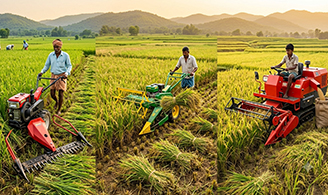
A paddy reaper is a relatively simple harvesting machine designed to cut standing paddy and lay the harvested crop in rows or windrows for subsequent collection and threshing.
Reapers are generally more compact than combines and can be suitable for small farms where farmers already have separate threshing arrangements.
Their smaller size can also make them useful in fields where larger machines have difficulty operating.
2. Reaper-Binder
A reaper-binder performs two operations by cutting the crop and tying it into bundles. This can reduce the manual effort involved in gathering harvested paddy.
It can be useful for farmers who prefer bundled crop handling rather than complete harvesting and threshing in a single operation.
However, farmers should consider the additional labour and equipment required for subsequent threshing.
3. Mini Paddy Harvester
A mini or compact paddy harvester is designed for smaller fields and areas where manoeuvrability is important. These machines can offer a balance between mechanisation and affordability.
They may be particularly useful for small landholdings, fragmented fields, and locations where larger harvesters cannot easily operate.
4. Combine Harvester
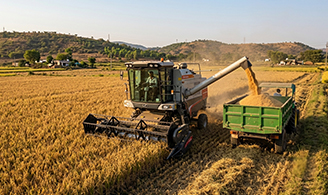
A combine harvester combines several harvesting operations in one machine. Depending on its design, it can cut, thresh, separate, and clean the harvested grain in a continuous operation.
This makes combines highly productive for larger areas. Compact and self-propelled versions can also be considered for smaller farms where farmers want to complete multiple harvesting operations mechanically.
However, purchase cost, maintenance, storage, field accessibility, and operating requirements need to be evaluated carefully before investing in a combine.
Also Read: Types of Harvesters for Modern Farming – Features & Uses
Understanding Harvester Capacity
Capacity is one of the most important factors when selecting a paddy harvester. It is generally expressed in terms of hectares per hour, acres per hour, tonnes per hour, or another manufacturer-defined measure.
However, advertised capacity should not be treated as a guaranteed field performance figure.
Actual harvesting capacity depends on:
- Crop yield
- Crop height
- Moisture level
- Lodging
- Field size and shape
- Soil condition
- Machine width
- Operating speed
- Operator experience
- Number of turns required
A larger machine may have a higher theoretical capacity, but a compact machine can sometimes be more practical on small, irregularly shaped fields.
How to Choose the Right Paddy Harvester
Choosing a paddy harvester should begin with an assessment of the farm rather than simply comparing machine specifications.
1. Consider Your Farm Size
For a small landholding, investing in a large combine may not always be economically justified. A smaller harvester or hiring a custom-hiring service could be more practical.
Farmers who own larger areas or provide harvesting services to neighbouring farms may benefit from a higher-capacity machine.
2. Evaluate Field Conditions
Field accessibility is critical. Narrow entrances, small plots, irregular boundaries, soft soil, bunds, and waterlogged conditions can affect machine performance.
Before purchasing, consider the machine's dimensions, ground clearance, turning radius, track or tyre configuration, and overall manoeuvrability.
3. Check Crop and Soil Conditions
Different paddy varieties can have different plant heights, stem strengths, and lodging characteristics. Soil moisture also affects machine movement.
A machine should be selected according to the conditions in which it will actually operate.
4. Consider Harvesting Functions
Farmers should determine whether they need only crop cutting or want a complete harvesting solution.
A reaper may be sufficient if threshing is performed separately. A combine harvester can be more suitable when cutting, threshing, separation, and cleaning need to be completed in one operation.
Rice Harvesting Machine Price: What Determines Cost?
The rice harvesting machine price varies considerably depending on the machine type, capacity, brand, features, automation, harvesting mechanism, and configuration.
A basic reaper generally requires a lower investment than a full-sized combine harvester. Compact machines occupy the middle ground, while advanced high-capacity combines can require a significantly higher investment.
Farmers should not compare machines based solely on their purchase price. The total cost of ownership should also be considered.
This includes:
- Purchase or financing cost
- Fuel consumption
- Routine servicing
- Spare parts
- Operator cost
- Transportation
- Storage
- Depreciation
- Insurance, where applicable
For small farmers, hiring a machine through a custom-hiring centre or agricultural service provider may sometimes be more economical than purchasing one.
Fuel Efficiency and Operating Costs
Fuel consumption can significantly influence harvesting costs. Two machines with similar harvesting capacities may have different operating expenses depending on engine specifications, field efficiency, and working conditions.
Farmers should ask manufacturers or dealers for practical information about fuel consumption and harvesting capacity under comparable conditions.
Regular maintenance can also help maintain fuel efficiency. Dirty filters, worn components, improper adjustments, and overloaded machines can increase operating costs.
Maintenance Requirements
A harvesting machine operates under demanding field conditions, so preventive maintenance is essential.
Before and during the harvesting season, inspect:
- Engine oil and filters
- Belts and chains
- Bearings
- Cutting components
- Threshing components
- Cleaning and separation systems
- Tyres or tracks
- Hydraulic systems
- Electrical connections
Crop residue, dust, and moisture should be removed regularly. Worn components should be replaced according to manufacturer recommendations.
Proper maintenance helps reduce unexpected downtime during the short paddy harvesting window.
Buying vs Hiring a Paddy Harvester
For small farms, purchasing is not always the only option. Machine hiring can provide access to mechanisation without requiring a large upfront investment.
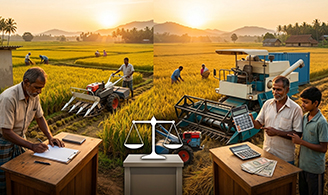
Hiring may be worth considering when:
- Farm size is small
- Harvesting is required only once or twice a year
- A reliable custom-hiring service is available
- The machine would otherwise remain unused for long periods
Purchasing can become more attractive when the machine will be used extensively, shared among multiple farmers, or used as a custom-hiring business.
Farmers should compare the annual cost of ownership with the local harvesting charges before making a decision.
Role of Mechanisation in Rice Farming
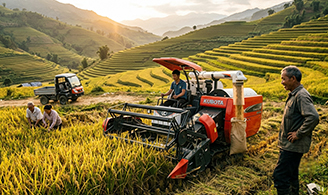
Modern rice farming increasingly depends on timely mechanisation. Paddy production involves several labour-intensive activities, including land preparation, transplanting or sowing, crop management, harvesting, and post-harvest handling.
Mechanised harvesting can help farmers manage labour shortages and complete harvesting within the desired period. It can also help reduce the physical workload associated with manual cutting and threshing.
As agricultural mechanisation develops, compact machines are becoming increasingly relevant for small and fragmented holdings.
Final Selection Checklist
Before purchasing a rice harvesting machine, farmers should ask:
- Is the machine suitable for my farm size?
- Can it operate effectively in my field conditions?
- What is its practical harvesting capacity?
- What crops and varieties is it designed for?
- What are its fuel and maintenance requirements?
- Are spare parts readily available?
- Is local service support available?
- What is the total ownership cost?
- Would hiring be more economical?
- Does the machine provide the harvesting functions I actually need?
Conclusion
Selecting the right paddy harvester can significantly improve harvesting efficiency, particularly when labour availability and harvesting time are major concerns. Small farmers have several options, ranging from reapers and reaper-binders to mini harvesters and compact combine harvesters.
The best choice depends on farm size, field conditions, crop characteristics, required harvesting operations, machine capacity, maintenance requirements, and budget. Instead of choosing a machine solely based on the advertised rice harvesting machine price, farmers should evaluate its total cost of ownership and expected utilisation.
With the right machine and proper maintenance, mechanised harvesting can help farmers complete rice farming operations more efficiently, reduce dependence on manual labour, and make better use of the critical harvesting window.
Recent Articles
Tag Cloud
Connect With Us

Sep 29, 2026
You May Also Like
- Read More
 Which is the Best Tractor for Farming in India?
Farming tractors are the essential companions of farmers; these robust machines help them work...
- Read More
 Choosing the Right Tractor for Groundnut Farming
Groundnut, or peanut, is grown in five states of India, namely Andhra Pradesh, Gujarat, Tamil Nadu, Karnataka, Rajasthan and Maharashtra.
- Read More
 Mahindra’s Tractor’s Potato Farming Guide
Paddy farming is one of India’s most prevalent farming methods that use small, flooded fields to cultivate rice.
- Read More
 Why Buy a Mahindra 275 DI XP Plus Tractor: Mileage, Features & Specs
The Indian Tractor market is unique—farmers are looking for an all-rounder tractor that satisfies all their needs while being affordable and powerful. One such tractor that meets the demands of Indian farmers is the Mahindra 275


 Not happy
 Could be better
 It's okay
 Good
Good Excellent