


Solar Power in Agriculture: Uses, Benefits & Farming Applications
Sep 29, 2026 | 5 Mins Read


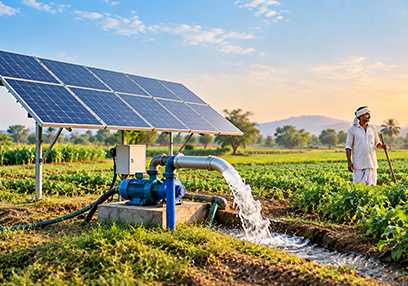
Table of Content
- What Is Solar Energy in Agriculture?
- Solar Irrigation Pumps for Farmers
- Understanding the PM KUSUM Scheme
- Benefits of Solar Power for Agriculture
- Solar Farming: An Emerging Opportunity
- Solar Energy and Modern Farming Technology
- Solar Power for Post-Harvest Activities
- What Should Farmers Consider Before Installing Solar Systems?
- Challenges of Solar Energy in Agriculture
- The Future of Solar Farming in India
- Conclusion
Agriculture is one of the most important sectors of the Indian economy, supporting millions of farming families across the country. However, farmers face several challenges, including rising energy costs, unreliable electricity supply in some regions, increasing diesel expenses, and the need for efficient irrigation. Solar energy in agriculture offers an opportunity to address many of these challenges by providing a clean, renewable, and increasingly accessible source of power for farm operations.
From solar-powered irrigation pumps to farm-based electricity generation, solar technology is becoming an important part of modern farming technology. Government initiatives such as the PM KUSUM scheme are also encouraging farmers to adopt solar power and reduce dependence on conventional energy sources. With suitable planning, solar farming can support irrigation, reduce operating expenses, and create additional opportunities for agricultural communities.
What Is Solar Energy in Agriculture?
Solar energy in agriculture refers to the use of sunlight to generate electricity or heat for farming-related activities. Solar photovoltaic (PV) panels convert sunlight into electricity, which can then be used to operate agricultural equipment and other farm facilities.
Some common applications include:
- Solar irrigation pumps
- Solar-powered farm lighting
- Solar-powered fencing
- Electricity for farm buildings
- Cold-storage and refrigeration support
- Crop drying
- Water pumping and distribution
- Renewable power generation on agricultural land
Solar systems can be particularly useful in rural areas where farmers want to reduce their dependence on grid electricity or diesel-powered equipment.
Solar Irrigation Pumps for Farmers
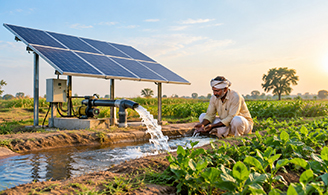
Irrigation is one of the most important applications of solar power in agriculture. Farmers require reliable water pumping for crops, especially in regions where rainfall is seasonal or unpredictable.
A solar irrigation system generally consists of solar panels, a pump, a controller, and the required water-delivery infrastructure. During daylight hours, the solar panels generate electricity that powers the pump and moves water from a suitable source to the field.
Compared with diesel pumps, solar pumps do not require regular diesel purchases or fuel transportation. They also have fewer fuel-related operating concerns.
However, farmers should select a solar pump according to water requirement, borewell or water-source characteristics, required pumping head, field size, and available sunlight. Professional assessment is important before installation.
Understanding the PM KUSUM Scheme
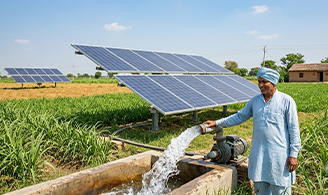
The PM KUSUM scheme-Pradhan Mantri Kisan Urja Suraksha evam Utthaan Mahabhiyan—is a major government initiative aimed at promoting solar energy applications in the agricultural sector.
The scheme broadly supports the deployment of decentralised renewable energy and solar-powered agricultural pumps, while also creating opportunities for farmers and other stakeholders to participate in renewable energy generation.
Depending on the component and applicable state-level implementation, the scheme can support activities such as installation of standalone solar agricultural pumps and solarisation of existing grid-connected agricultural pumps.
Farmers should check the latest guidelines, eligibility requirements, subsidy structure, and application process applicable in their state because implementation details can vary.
Benefits of Solar Power for Agriculture
The adoption of solar power can provide several potential benefits to farmers.
1. Lower Dependence on Diesel
Diesel-powered irrigation pumps can result in recurring fuel expenses. Solar pumps use sunlight as their energy source, which can reduce dependence on diesel for irrigation.
2. Renewable Energy Source
Solar power is renewable and uses an abundant natural resource—sunlight. This makes it a potentially sustainable energy solution for agricultural operations.
3. Reduced Operating Costs
Once a solar system has been installed, its energy generation does not require regular fuel purchases. Although the initial investment can be significant, reduced energy expenses may provide long-term economic benefits.
4. Support for Reliable Irrigation
Where grid electricity is unavailable or unreliable, solar irrigation systems can provide farmers with an alternative source of power during suitable daylight conditions.
5. Environmentally Friendly Farming
Replacing a portion of fossil-fuel-based energy with solar power can reduce greenhouse gas emissions associated with farm energy consumption.
Solar Farming: An Emerging Opportunity
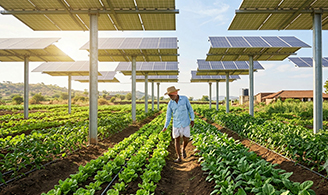
Solar farming generally refers to generating electricity using solar photovoltaic systems installed on land. In an agricultural context, solar installations can potentially create an additional source of income or energy when appropriately planned.
One approach is to use suitable non-agricultural or designated land for solar power generation. Another emerging concept is agrivoltaics, where solar panels and agricultural production are combined on the same land under suitable conditions.
Agrivoltaic systems can be designed to allow crops to grow beneath or between solar panels, depending on crop characteristics, panel arrangement, local climate, and available technology. However, such systems require careful planning because excessive shading or unsuitable layouts can affect crop productivity.
Solar Energy and Modern Farming Technology
The future of agriculture is increasingly connected with technology. Modern farming technology combines mechanisation, precision agriculture, digital monitoring, automation, renewable energy, and data-driven decision-making.
Solar power can complement these technologies by providing electricity for agricultural devices and systems.
For example, solar energy can support:
- Automated irrigation controllers
- Soil-moisture monitoring systems
- Weather stations
- Remote farm sensors
- Electric farm equipment
- Water-level monitoring
- Farm lighting
- Agricultural IoT devices
When renewable energy is combined with smart irrigation and precision farming, farmers can potentially improve resource-use efficiency while reducing unnecessary energy consumption.
Also Read: What Is GPS Technology in Farming and How Does It Help Farmers?
Solar Power for Post-Harvest Activities
The benefits of solar energy are not limited to crop production. Agriculture also requires energy after harvesting for activities such as drying, storage, cooling, processing, and transportation.
Solar-powered crop dryers can help reduce dependence on traditional drying methods under suitable conditions. Solar electricity can also support refrigeration and cold-storage systems, subject to system capacity and operational requirements.
Reliable electricity for post-harvest infrastructure can help farmers and agricultural businesses manage produce more efficiently and potentially reduce losses.
What Should Farmers Consider Before Installing Solar Systems?
Solar power can be highly useful, but installation should be based on actual farm requirements rather than simply choosing the largest available system.
Farmers should consider:
- Energy requirement: Determine how much electricity or pumping capacity is required.
- Water requirement: For irrigation, assess the water source, required flow rate, pumping head, and irrigation schedule.
- Solar radiation: Local sunlight availability affects system performance.
- System size: Select solar panels and pump capacity according to actual requirements.
- Installation site: Panels should have sufficient exposure to sunlight and minimal shading.
- Initial investment: Consider equipment, installation, infrastructure, maintenance, and financing.
- Maintenance: Solar panels, wiring, controllers, pumps, and other components require periodic inspection.
- Government support: Check current state and central government programmes, including applicable PM KUSUM scheme provisions.
Challenges of Solar Energy in Agriculture
Despite its advantages, solar adoption has some limitations. The initial installation cost can be considerable, particularly for larger systems. Solar generation also depends on sunlight, meaning output can vary with weather and time of day.
Solar pumping systems can also encourage excessive groundwater extraction if irrigation is not managed responsibly. Therefore, solar energy should ideally be combined with efficient irrigation practices such as drip or sprinkler irrigation, soil-moisture monitoring, and appropriate water-management strategies.
Farmers should also ensure that systems are installed by qualified professionals and maintained according to manufacturer recommendations.
The Future of Solar Farming in India
India has substantial solar-energy potential and agriculture offers numerous opportunities for renewable energy adoption. As solar technology becomes more efficient and accessible, its role in farming is likely to expand.
The combination of solar pumps, efficient irrigation, agricultural mechanisation, digital technologies, and renewable electricity can contribute to a more sustainable agricultural ecosystem.
Solar farming may also become an important component of rural energy generation, particularly where suitable land, infrastructure, policies, and economic models support such projects.
Conclusion
Solar energy in agriculture has the potential to transform how Indian farmers meet their energy requirements. From powering irrigation pumps and farm equipment to supporting post-harvest operations and modern farming technology, solar power can reduce dependence on conventional energy sources while supporting more sustainable agricultural practices.
Government initiatives such as the PM KUSUM scheme are helping expand the use of solar technologies in agriculture, although farmers should always verify the latest eligibility criteria and state-specific implementation guidelines before investing.
The future of Indian agriculture will increasingly depend on efficient use of water, energy, labour, and technology. By combining renewable energy with precision irrigation, mechanisation, and other modern farming technology, farmers can build more efficient and resilient farming systems. With appropriate planning and responsible resource management, solar power can become an important part of India's transition towards cleaner, smarter, and more sustainable agriculture.
Recent Articles
Tag Cloud
Connect With Us

Sep 29, 2026
Sep 29, 2026

You May Also Like
- Read More
 Which is the Best Tractor for Farming in India?
Farming tractors are the essential companions of farmers; these robust machines help them work...
- Read More
 Choosing the Right Tractor for Groundnut Farming
Groundnut, or peanut, is grown in five states of India, namely Andhra Pradesh, Gujarat, Tamil Nadu, Karnataka, Rajasthan and Maharashtra.
- Read More
 Mahindra’s Tractor’s Potato Farming Guide
Paddy farming is one of India’s most prevalent farming methods that use small, flooded fields to cultivate rice.
- Read More
 Why Buy a Mahindra 275 DI XP Plus Tractor: Mileage, Features & Specs
The Indian Tractor market is unique—farmers are looking for an all-rounder tractor that satisfies all their needs while being affordable and powerful. One such tractor that meets the demands of Indian farmers is the Mahindra 275


 Not happy
 Could be better
 It's okay
 Good
Good Excellent