


Top 10 4WD Tractors in India: Prices, Features & Specifications
Oct 30, 2026 | 5 Mins Read


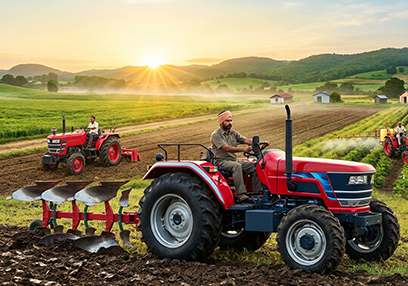
Table of Content
4WD tractors give farmers stronger traction, better control, and more confidence when working in wet soil, loose fields, orchards, slopes, or demanding tillage conditions. For Indian farms, the right 4WD tractor depends on crop type, field size, implement requirements, and the tractor HP guide appropriate for daily work.
This guide highlights 10 Mahindra 4WD tractor options across compact, utility, and higher-power applications. It also explains how to compare tractor price, features, and specifications before making a purchase decision.
Why Choose 4WD Tractors for Indian Farming?
A 4WD tractor sends power to both the front and rear wheels, helping it maintain grip where a two-wheel-drive tractor may experience wheel slip. This makes 4WD tractors especially useful for farmers who work in challenging soil conditions or use heavy implements.
The biggest advantage is improved traction. With all four wheels contributing to movement, the tractor can pull implements more effectively while reducing excessive wheel spin. This can be valuable during land preparation, puddling, rotavator work, plowing, haulage on uneven ground, and operations in horticulture fields.
4WD can also support better stability and steering control. Front-wheel drive engagement helps the tractor move more confidently through muddy patches, slopes, and uneven surfaces. However, farmers should use 4WD thoughtfully: it is generally most beneficial in low-grip field conditions rather than on dry, hard roads.
Before selecting a model, consider these factors:
- Soil condition: Wet, sandy, loose, or black-cotton soil may call for stronger traction.
- Crop and farm type: Orchards, vineyards, sugarcane fields, paddy farms, and broad-acre operations have different needs.
- Implement requirement: Match the tractor to rotavators, cultivators, plows, seed drills, loaders, or other equipment.
- Working width: Compact tractors suit narrow rows, while larger machines support wider implements.
- Power requirement: Use a tractor HP guide to avoid paying for power that your operations do not need—or choosing too little power for heavy work.
Top 10 Mahindra 4WD Tractors in India
The best 4WD tractor is not always the highest-HP model. A compact tractor may be the better choice for an orchard, while a heavier model may be more suitable for intensive field preparation. The following shortlist covers a broad range of Mahindra 4WD tractors and applications.
| Mahindra 4WD tractor | Approximate power category | Suitable applications | Key buying consideration | Tractor price guidance |
|---|---|---|---|---|
| Mahindra OJA 2121 4WD | 21 HP | Orchards, inter-cultivation, small farms | Compact size for confined spaces | Request current dealer quotation |
| Mahindra OJA 2124 4WD | 24 HP | Horticulture, spraying, light tillage | Useful balance of maneuverability and power | Varies by location and configuration |
| Mahindra JIVO 245 DI 4WD | 24 HP | Vineyard and orchard operations | Designed for narrow-row farming needs | Confirm local on-road price |
| Mahindra OJA 2127 4WD | 27 HP | Small-to-medium farms, cultivation | Extra power for more implement flexibility | Ask dealer about available offers |
| Mahindra OJA 2130 4WD | 30 HP | Tillage, haulage, horticulture | Suitable for farmers needing a compact utility tractor | Compare base price and accessories |
| Mahindra OJA 3132 4WD | 32 HP | Field work, inter-cultivation, implements | Higher utility capability in a compact format | Check state-wise pricing |
| Mahindra OJA 3136 4WD | 36 HP | Cultivation, rotary work, commercial farming | A stronger choice for regular implement use | Verify applicable taxes and registration |
| Mahindra OJA 3140 4WD | 40 HP | Medium farm operations and heavier implements | Consider implement compatibility before purchase | Obtain an authorized quote |
| Mahindra YUVO TECH+ 475 4WD | 42 HP | Tillage, sowing, haulage, multi-crop farming | Suitable for higher-duty utility work | Price depends on variant and location |
| Mahindra ARJUN NOVO 605 DI-i 4WD | Around 50 HP class | Heavy-duty field preparation and large farms | Built for demanding implement applications | Speak with a Mahindra dealer for pricing |
1.Compact options: OJA and JIVO series
Mahindra OJA and JIVO tractors can be practical choices where maneuverability is as important as traction. Their compact dimensions can help farmers work in orchards, vineyards, vegetable plots, and row-crop fields with limited turning space.
The OJA 2121, OJA 2124, OJA 2127, and OJA 2130 4WD models cover lower-power requirements while offering the added control of four-wheel drive. The JIVO 245 DI 4WD is also relevant for specialized farming environments where working between rows matters.
2. Utility options: OJA 3132, 3136, and 3140
Farmers who need more capacity for regular cultivation, rotary work, and general-purpose implements may consider the OJA 3132, OJA 3136, and OJA 3140 4WD tractors. These models sit in a power range that can suit mixed farming operations, provided the selected implement is correctly matched to the tractor.
3. Higher-power options: YUVO TECH+ and ARJUN NOVO
For more demanding agricultural work, the YUVO TECH+ 475 4WD and ARJUN NOVO 605 DI-i 4WD offer higher power categories. These tractors may be considered for larger fields, deeper tillage, substantial haulage requirements, and heavy implement use. Farmers should review PTO needs, hydraulic lifting requirements, tire selection, and implement width before finalizing a model.
How to Compare Tractor Price, Features, and Specifications
A tractor price should be compared carefully because the final amount can differ by state, dealership, financing plan, insurance, registration requirements, accessories, and seasonal offers. The best approach is to request a written quotation from an authorized Mahindra Tractors dealer for the exact variant you are considering.
When comparing quotations, ask whether the price includes:
- Tractor variant and 4WD configuration
- Front and rear tire specifications
- Required accessories or ballast
- Insurance, registration, and applicable charges
- Warranty details and service support
- Finance options and down-payment requirements
- Implements purchased as part of the package
Do not compare tractors only by HP or purchase price. A lower-priced tractor may not be suitable if it cannot operate the implements needed on your farm. Similarly, a high-power tractor may add unnecessary ownership costs when a compact model can complete the work efficiently.
Important specifications to check include engine power, PTO power, transmission options, hydraulic lifting capacity, wheelbase, ground clearance, turning radius, tire size, and hydraulic outlets. These details influence how the tractor performs with specific implements and field conditions.
For dependable ownership, also consider service access. Mahindra Tractors has an extensive dealership and service network across India, helping farmers access product guidance, maintenance support, and genuine parts.
How to Select the Best 4WD Tractor for Your Farm
Start by listing the work your tractor must complete during the busiest season. Include primary tillage, rotavator work, puddling, sowing, spraying, intercultural work, haulage, and any specialized horticulture activity. Then identify the largest or heaviest implement you intend to use.
A simple tractor HP guide can help narrow the decision:
- 21–30 HP: Often suitable for small farms, orchards, vineyards, vegetable cultivation, and lighter implements.
- 30–40 HP: A practical range for mixed farming, regular cultivation, medium-duty rotary work, and haulage.
- 40–50 HP and above: Better suited to heavier implements, larger farm areas, and more intensive field preparation.
Field width is equally important. A compact 4WD tractor can be more productive in a narrow orchard than a larger tractor that struggles to turn between rows. In contrast, broad-acre farmers may benefit from a larger machine that can operate wider implements and cover more land in less time.
Finally, arrange a dealer discussion or product demonstration where possible. Share your crop pattern, soil type, acreage and existing implements. This helps ensure the tractor, implement, and tire combination is selected for real working conditions—not only brochure comparisons.
Key takeaways
- 4WD tractors improve traction, stability, and control in wet, uneven, loose, and demanding field conditions.
- The best 4WD tractor depends on farm size, crop pattern, soil, row spacing, and implement requirements.
- Mahindra offers 4WD options from compact OJA and JIVO models to higher-power YUVO TECH+ and ARJUN NOVO tractors.
- Always compare complete dealer quotations, not only the advertised tractor price.
- Match HP, hydraulics, PTO needs and implement size before purchasing.
Frequently asked questions
1. Which is the best 4WD tractor for small farms?
For small farms, orchards, and narrow-row operations, compact models such as the Mahindra OJA 2121 4WD, OJA 2124 4WD, or JIVO 245 DI 4WD may be suitable. The right choice depends on row spacing and implement needs.
2. Are 4WD tractors better than 2WD tractors?
4WD tractors are generally better where traction is a priority, such as wet soil, loose land, slopes, and heavy implement work. A 2WD tractor may still be suitable for lighter work on dry, level fields.
3. What HP tractor is needed for a rotavator?
The required HP depends on the rotavator width, soil condition, and working depth. Check the implement manufacturer’s power recommendation and confirm compatibility with the tractor dealer before purchase.
4. What affects tractor price in India?
Tractor price can vary by model, variant, state, insurance, registration charges, accessories, finance plan, and dealership offers. Request an authorized quotation for the final applicable price.
5. Should I buy a 4WD tractor for orchard farming?
A 4WD tractor can be useful in orchards where traction and stability are needed, particularly on uneven or loose ground. Choose a compact model that fits safely between trees and crop rows.
Recent Articles
Tag Cloud
Connect With Us

Oct 29, 2026
Oct 30, 2026

You May Also Like
- Read More
 Which is the Best Tractor for Farming in India?
Farming tractors are the essential companions of farmers; these robust machines help them work...
- Read More
 Choosing the Right Tractor for Groundnut Farming
Groundnut, or peanut, is grown in five states of India, namely Andhra Pradesh, Gujarat, Tamil Nadu, Karnataka, Rajasthan and Maharashtra.
- Read More
 Mahindra’s Tractor’s Potato Farming Guide
Paddy farming is one of India’s most prevalent farming methods that use small, flooded fields to cultivate rice.
- Read More
 Why Buy a Mahindra 275 DI XP Plus Tractor: Mileage, Features & Specs
The Indian Tractor market is unique—farmers are looking for an all-rounder tractor that satisfies all their needs while being affordable and powerful. One such tractor that meets the demands of Indian farmers is the Mahindra 275


 Not happy
 Could be better
 It's okay
 Good
 Excellent